
For the last few years, we’ve argued endlessly about where work should happen.
Remote. Hybrid. Back to office. Four days a week. Flexible Fridays.
It’s been a lively debate, and in many ways, a distracting one.
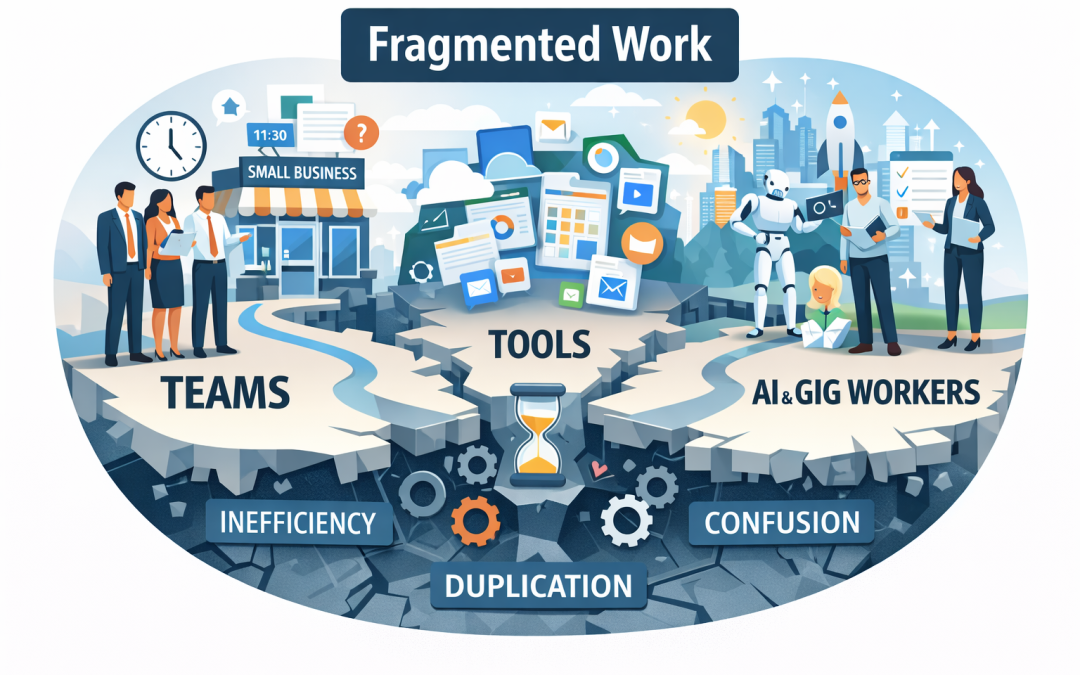
Because the real shift in how work happens isn’t about where people sit. It’s about how work is now split, stretched, and stitched together across humans, tools, platforms, vendors, and time zones.
The future of work isn’t remote or hybrid. It’s fragmented.
In case of a small businesses in particular, that fragmentation is quietly becoming the biggest operational challenge of the next decade.
“The real competitive advantage won’t be speed, it will be coherence.”
What We Mean by ‘Fragmented Work’
Fragmented work doesn’t mean disorganised people. It means work is now distributed across more moving parts than ever before.
A typical small business today might involve:
- a core in-house team
- freelancers or gig workers
- outsourced vendors
- cloud-based tools and CRMs
- automation and AI platforms
- clients spread across locations and time zones
Each of these elements may work well on its own. The problem begins between them.
According to McKinsey’s research on the future of work, organisations are increasingly operating as “networks of teams” rather than linear hierarchies but many lack the coordination mechanisms to support that shift effectively.
Large enterprises struggle with this. Small businesses feel it even more, because they have fewer buffers.
Why Small Businesses Feel Fragmentation First
Small businesses are agile, fast-moving, and adaptable.But they are also lean.
That means when fragmentation shows up, it shows up as:
- duplicated work
- missed handovers
- inconsistent customer experiences
- unclear ownership
- decision fatigue
The OECD’s research on small business productivity highlights that smaller firms often adopt new tools faster than they adapt their processes, leading to inefficiencies that quietly compound over time.
In other words: Technology arrives quickly. Structure lags behind, and fragmentation fills the gap.
Fragmentation Isn’t a People Problem, It’s a Design Problem
This is where many leaders get stuck.
When things start slipping in forms of delays, confusion, dropped balls, the instinct is to assume:
- people aren’t aligned
- someone isn’t pulling their weight
- communication needs “improving”
But in most cases, people are doing their best inside poorly designed systems.
Harvard Business Review, in its work on organisational effectiveness, points out that coordination failures rarely stem from individual capability, they rather stem from unclear processes, roles, and decision rights.
Fragmentation doesn’t mean people don’t care. It means the system doesn’t help them succeed.
The Hidden Cost: When Customers Feel the Gaps
Customers are remarkably good at sensing internal fragmentation, even when they can’t name it.
They feel it when:
- they repeat the same information twice
- one person promises something another can’t deliver
- responses are slow because “we’re waiting on someone else”
- handovers feel clunky or impersonal
According to Salesforce’s State of the Connected Customer, over 70% of customers expect connected experiences, and frustration rises sharply when teams appear disconnected behind the scenes.
The customer doesn’t care that your:
- freelancer uses a different tool
- vendor has a different process
- CRM doesn’t sync properly
They only care about how it feels.
“Your customer shouldn’t need a translator between your systems or your teams.”
Why Fragmentation Is About to Accelerate (Not Slow Down)
If anything, fragmentation is just getting started. Three forces are accelerating it:
1. The Rise of the Gig and Project Economy
According to World Economic Forum data, project-based work and flexible talent models are becoming standard, not exceptional. Small businesses will increasingly rely on specialists rather than full-time generalists.
2. Tool Proliferation
Gartner reports that the average organisation uses dozens of SaaS tools, often adopted reactively rather than strategically. Each tool solves a problem, but collectively they can create confusion if not aligned.
3. AI as a New ‘Team Member’
AI tools don’t replace thinking, they rather amplify whatever structure already exists. As MIT Sloan has noted, AI improves productivity only when paired with clear processes and governance.
Fragmentation isn’t a temporary phase. It’s the operating environment.
The Real Risk: Mistaking Activity for Progress
One of the most dangerous side effects of fragmented work is that everyone appears busy.
Messages are sent. Tasks are completed. Dashboards are full. But outcomes feel fuzzy.
Deloitte’s research on organisational performance shows that productivity drops when coordination costs rise, even when individual effort increases.
This is how businesses end up:
- working harder without moving faster
- adding tools instead of removing friction
- hiring more people to compensate for unclear processes
Fragmentation is exhausting precisely because it hides behind effort.
What Coherence Actually Looks Like
Coherence doesn’t mean simplicity for its own sake. It means intentional design.
Coherent organisations share a few traits:
- clear ownership across workflows
- shared definitions of success
- consistent use of systems (especially CRM)
- documented handovers and decision paths
- fewer assumptions, more clarity
As McKinsey puts it, high-performing organisations invest as much in how work flows as they do in what work gets done.
That investment pays off in calmer teams, clearer decisions, and better customer experiences.
A Pattern I See Repeatedly
I often work with small businesses that feel “busy but stuck”.
They’re growing but it feels heavier than it should. They’re hiring but clarity decreases instead of increasing. They’re investing in tools but confidence doesn’t rise.
When we step back, the issue isn’t ambition or talent. It’s fragmentation without coordination.
Once workflows are clarified, systems aligned, and roles made explicit, something shifts:
- fewer meetings
- faster decisions
- smoother customer journeys
Not because people worked harder. Because the work finally made sense.
Why Coherence Will Be the Next Competitive Advantage
In a fragmented future, speed alone won’t save you. Everyone can move fast.
What’s harder, and rarer, is moving together.
Businesses that win will be those that:
- design for coordination, not heroics
- treat process as an enabler, not bureaucracy
- align humans and technology deliberately
- reduce friction before it reaches customers
“Fragmentation is inevitable. Confusion is optional.”
How Vani Malik Consulting Helps Businesses Build Coherence
At Vani Malik Consulting, we help small and growing businesses make sense of fragmented work environments.
We support leaders by:
- mapping workflows across teams, vendors, and tools
- aligning CRM and operational processes
- reducing duplication and invisible work
- designing systems that support clarity, not chaos
Not by adding complexity, but by creating coherence that lasts.
If your business feels stretched, busy, or harder than it should be, the problem may not be effort. It may be fragmentation, quietly running the show.
Learn more or start a conversation at Vani Malik Consulting.

Hi, I’m Vani Malik, a business consultant now based in Colchester. For over 20 years, I’ve worked with global background screening and HR service companies, supporting clients across Europe, Asia, and North America.