
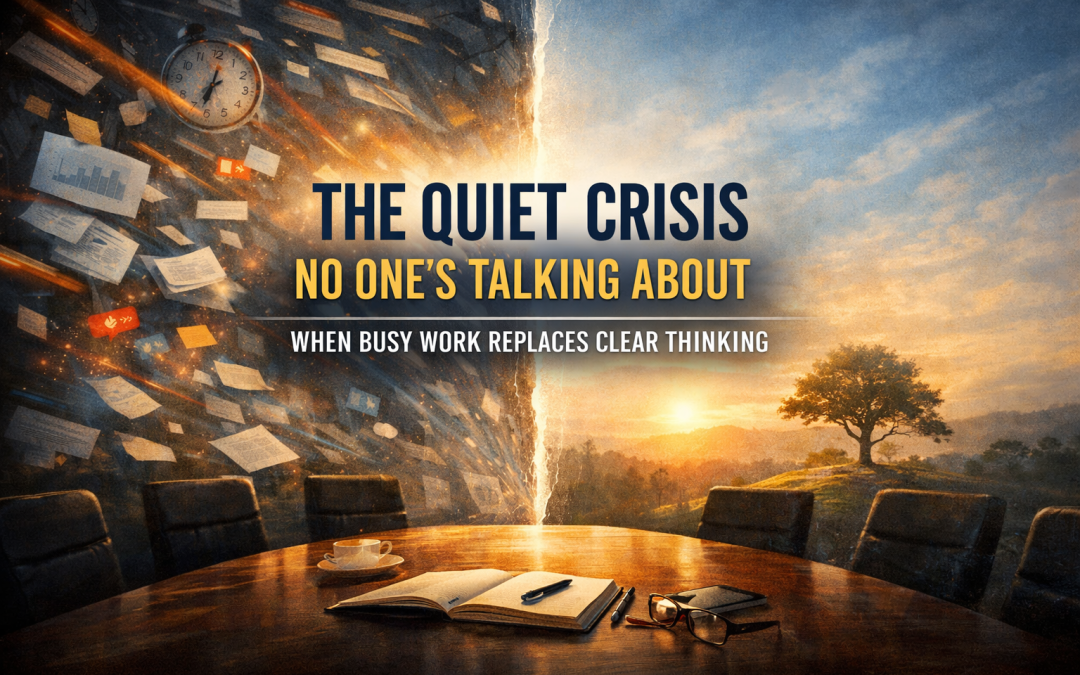
“The greatest danger in times of turbulence is not the turbulence itself, but acting with yesterday’s logic.” – Peter Drucker
Most leaders I speak to aren’t burnt out.
They’re informed, they’re busy, they’re capable and yet something feels off.
Decisions feel heavier than they should. Conversations go in circles. Strategy exists, but it’s oddly hard to articulate without slides. There’s a constant sense of motion, but very little stillness.
This isn’t a motivation problem or a talent problem and it certainly isn’t a lack-of-effort problem.
It’s a thinking problem, and it’s quietly becoming one of the biggest threats to modern businesses.
When Work Crowds Out Thought
Somewhere along the way, work began to crowd out thinking.
Calendars filled up, tools multiplied, meetings became default responses to uncertainty and urgency became a proxy for importance.
We now live in organisations where:
- Leaders attend back-to-back meetings about decisions they never quite make
- Teams execute quickly but struggle to explain why
- Strategy is reviewed often, but rarely reflected on
“We are drowning in information but starved for wisdom.” – E.O. Wilson
The problem isn’t information but rather saturation and saturation kills judgement.
Busy Feels Productive. Thinking Feels Indulgent.
There’s an unspoken rule in many businesses: If you’re thinking, you’d better look busy doing it.
Deep thought has no obvious output. Reflection doesn’t show up on dashboards.
Clarity doesn’t arrive with notifications. So, it gets deprioritised.
Ironically, this is exactly how organisations become slower, not faster.
Henry Mintzberg, one of the most respected management thinkers, warned years ago that organisations confuse activity with effectiveness – a mistake that only compounds over time.
Sound familiar?
A Pattern I’ve Seen Repeatedly
I’ve worked with organisations that had:
- Smart leaders
- Capable teams
- The “right” tools
- The “right” intentions
Yet decisions kept circling the same table. Everyone was busy and yet no one was clear.
When we slowed things down, not dramatically, just deliberately, something interesting happened. The problem wasn’t complexity. It was noise.
Too many inputs. Too many opinions. Too little space to think.
Once clarity returned, progress followed naturally.
What History Keeps Trying to Tell Us
This isn’t a new problem; Abraham Lincoln was known for taking long walks alone before major decisions. He believed distance from noise created perspective.
Albert Einstein famously said: “The thinking that got us into this problem is not the thinking that will get us out of it.”
Even ancient governance systems understood this. The Roman Senate wasn’t designed for speed, it was designed for deliberation. Debate was a feature, not a flaw.
Across time, cultures have understood one thing consistently: Good judgement requires space.
The Cognitive Cost of Constant Urgency
Modern research backs this up.
Daniel Kahneman, Nobel Prize–winning psychologist, explains in Thinking, Fast and Slow that humans rely on fast, reactive thinking under pressure and that this mode is prone to bias, shortcuts, and error.
Fast thinking is useful. But it’s dangerous when it becomes the default.
When organisations live permanently in “urgent mode,” they:
- Overvalue recent information
- Undervalue long-term consequences
- Default to familiar solutions
- Avoid uncomfortable but necessary decisions
In short, they react instead of reason.
When Strategy Becomes Performance Theatre
One of the quiet casualties of this crisis is strategy itself.
Strategy turns into:
- Slides instead of choices
- Vision statements instead of trade-offs
- Workshops instead of decisions
Harvard Business Review (HBR, Michael Porter)has repeatedly pointed out that the absence of clear choices, not lack of ambition, is what weakens most strategies.
“The essence of strategy is choosing what not to do.” That choice requires thinking and thinking requires space.
What Clear Organisations Do Differently
The organisations that cut through noise don’t do more. They do less, deliberately.
They:
- Protect time for thinking, not just doing
- Reduce decision points instead of increasing meetings
- Make ownership unmistakably clear
- Value coherence over constant motion
They understand something counterintuitive: Speed comes from clarity, not urgency.
This Isn’t About Slowing Down, It’s Rather About Seeing Clearly
Let’s be clear, this isn’t an argument for moving slowly. It’s rather an argument for thinking before moving.
For designing organisations where:
- Leaders aren’t cognitive bottlenecks
- Teams understand intent, not just tasks
- Decisions don’t depend on exhaustion or heroics
When thinking returns, confidence follows. When clarity returns, momentum becomes sustainable.
Why This Matters Now
Work is more fragmented than ever.
Teams are distributed. AI and automation are accelerating decisions. Attention is scarce.
Noise is constant. In this environment, the next competitive advantage won’t be speed.
It will be the ability to think clearly when everyone else is reacting.
A Final Thought
The quiet crisis in modern business isn’t lack of effort. It’s lack of space.
Space to think. Space to reflect. Space to decide well.
At Vani Malik Consulting, we help businesses reduce noise, restore clarity, and design ways of working that allow leaders and teams to think again – not as a luxury, but as a necessity. The future doesn’t belong to the busiest organisations but rather belongs to the clearest ones.

Hi, I’m Vani Malik, a business consultant now based in Colchester. For over 20 years, I’ve worked with global background screening and HR service companies, supporting clients across Europe, Asia, and North America.