
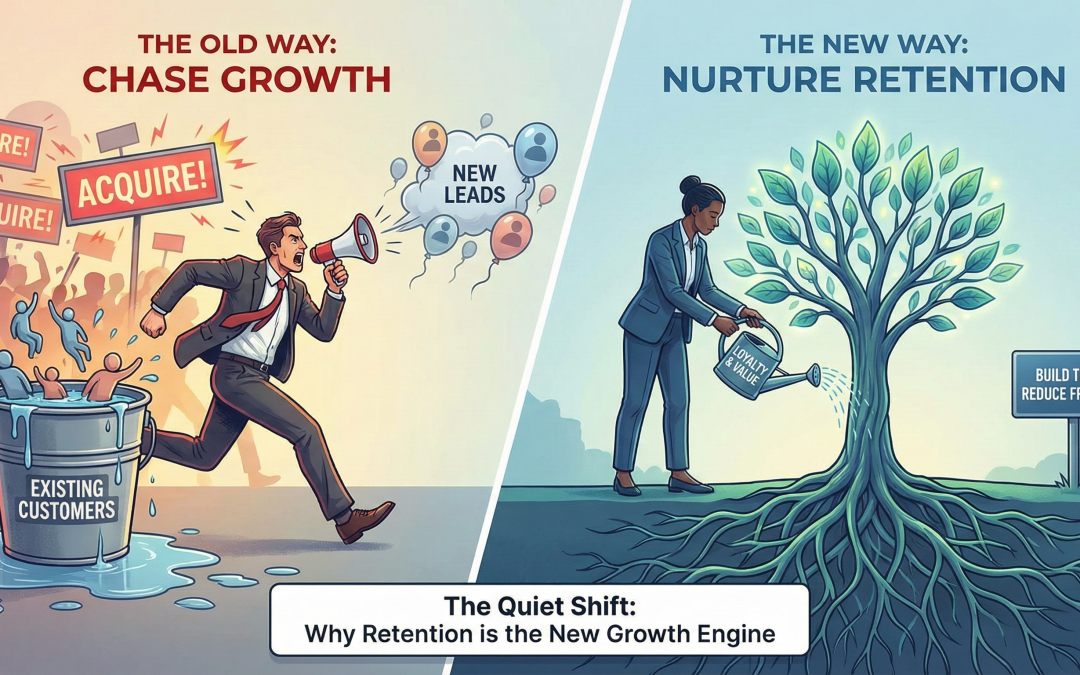
For years, business growth followed a familiar script: attract more leads, close more deals, repeat. But that model is quietly breaking.
Customer acquisition is becoming more expensive, competition louder, and attention harder to earn. What’s emerging in its place is something less flashy but far more powerful.
Retention.
Not as a side effect of growth, but as the strategy itself.
According to Bain & Company’s widely cited research on customer loyalty, increasing customer retention rates by as little as 5% can increase profits by 25% to 95%. Bain also points out that acquiring a new customer can cost five to seven times more than retaining an existing one.
Yet many organisations still invest the majority of their time, energy, and budget chasing new customers, while quietly neglecting the ones they already have.
And customers notice.
“Customers don’t drift away — they’re pushed away by friction.”
Why Loyalty Is Quietly Becoming the Real Battleground
The problem isn’t that businesses don’t care about loyalty. It’s that loyalty is often assumed rather than designed.
Harvard Business Review, in its analysis of customer retention, highlights that most customers don’t leave because of one major failure. They leave after a series of small disappointments – delayed responses, mixed messages, repeated explanations, that erode trust over time.
These moments rarely trigger alarms internally. Externally, they shape the entire relationship.
Salesforce’s “State of the Connected Customer” report reinforces this shift. It shows that over 60% of customers say they will switch brands after a single poor experience, and consistency matters more than price or features.
In other words, loyalty today isn’t emotional attachment, it’s confidence.
Confidence that the business will:
- remember them
- follow through
- show up the same way every time
The Real Reason Customers Leave (And Why It’s Rarely Obvious)
From the inside, most organisations feel busy, capable, and well-intentioned. Teams work hard. Tools are in place. Dashboards are full. But from the customer’s perspective, something else is happening.
Zendesk’s Customer Experience Trends report shows that customers increasingly value effortless experiences, and frustration grows when they have to repeat information, wait too long, or deal with internal handoffs.
That friction usually comes from misalignment:
- Sales promises one thing
- Operations delivers another
- Support tries to repair the gap
No single moment feels catastrophic. But together, they slowly push customers away.
McKinsey’s research on customer engagement consistently shows that organisations with aligned customer journeys and shared data across teams significantly outperform those operating in silos, not because they work harder, but because they remove friction before it becomes visible.
Retention Is Not a Department, It’s an Operating Model
One of the most damaging myths in business is that customer retention “belongs” to customer success or support.
It doesn’t.
Retention is created in:
- how CRMs are used (or misused)
- how information is shared
- how expectations are set
- how consistently teams communicate
Gartner’s customer experience research makes this clear: loyalty is driven less by exceptional moments and more by predictable reliability. Customers trust businesses that feel organised, aligned, and intentional.
That trust doesn’t come from slogans or values posters. It comes from structure.
The Boring Work That Builds Loyalty
Retention isn’t built through grand gestures. It’s built through unglamorous discipline.
Deloitte’s work on customer-centric transformation highlights that organisations which embed consistency into processes, rather than relying on individual heroics achieve stronger customer loyalty and more sustainable growth.
That looks like:
- one shared view of the customer
- clear ownership of handovers
- standardised CRM behaviour
- proactive communication instead of reactive fixes
Customers rarely comment on these things when they’re done well.
They only notice when they’re missing.
A Pattern Seen Repeatedly
I’ve worked with organisations where churn felt mysterious. The product was solid. The people were capable. Leadership was committed.
But when we looked closer, the signs were clear:
- customer data scattered across systems
- different teams telling different stories
- follow-ups depending on individual effort rather than process
Nothing was “broken”. But nothing was fully aligned either.
Once clarity was restored, through journey mapping, CRM alignment, and consistent communication, retention improved without any dramatic changes.
No new campaigns. No new tools. Just fewer gaps.
Why Retention Will Define the Next Era of Growth
As markets tighten and acquisition costs rise, loyalty will separate businesses that survive from those that scramble.
The future belongs to organisations that:
- reduce friction before it becomes frustration
- align systems so customers don’t fall through cracks
- value long-term relationships over constant acquisition
- treat clarity as a leadership responsibility
Because customers don’t expect perfection. They expect coherence. And coherence builds trust.
How Vani Malik Consulting Helps Organisations Strengthen Retention
At Vani Malik Consulting, we help businesses move from reactive retention to deliberate, structured loyalty.
Our work focuses on:
- aligning customer journeys across teams
- optimising CRM usage and data integrity
- reducing friction in handovers and processes
- building operational clarity that customers can feel
Not through more complexity, but through simplification that lasts.
If your organisation is seeing early signs of churn, inconsistency, or customer fatigue, we help address the root causes before loyalty quietly erodes.
Learn more at Vani Malik Consulting or get in touch to start a conversation.

Hi, I’m Vani Malik, a business consultant now based in Colchester. For over 20 years, I’ve worked with global background screening and HR service companies, supporting clients across Europe, Asia, and North America.