
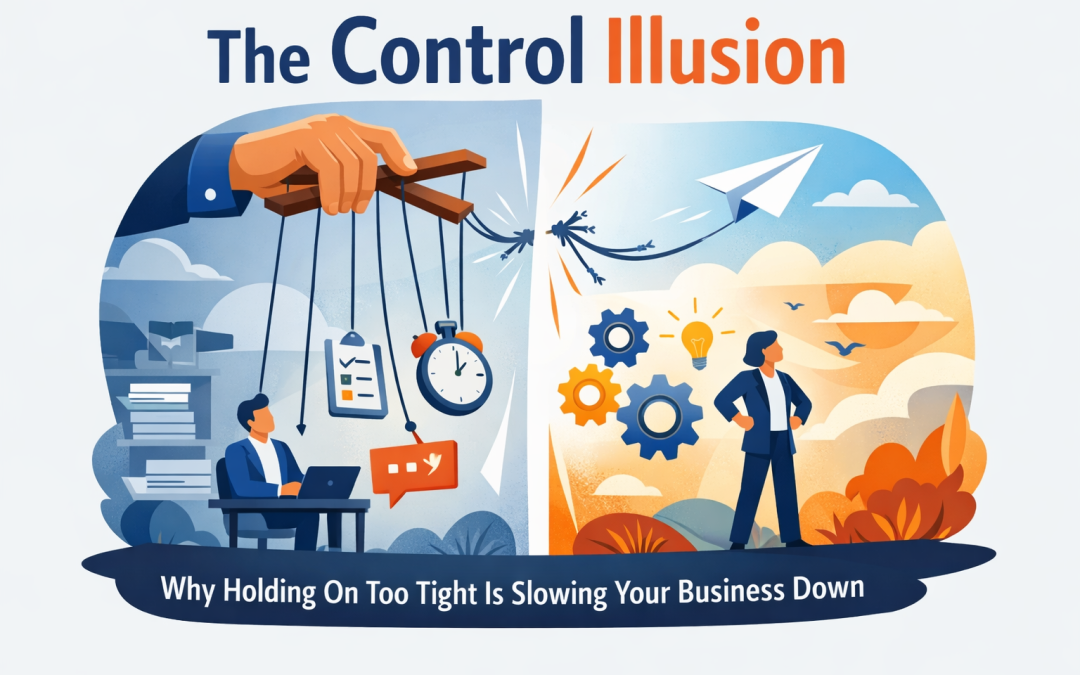
Why Holding On Too Tight Is Slowing Your Business Down
Last Tuesday, a founder told me something that made me laugh, not because it was funny, rather because it was painfully familiar.
She said,
“I just need two uninterrupted days to think about strategy. That’s all. Two days. Then everything will be fine.”
She said it like someone asking the universe for a long weekend. We both knew it wasn’t going to happen. Her phone buzzed three times while we were talking.
Slack. Email. “Quick question.” “Just checking.” “Do you have five minutes?”
She glanced at every notification without opening them, the way you look at a toddler you’re pretending not to hear.
“I don’t know why everything needs me,” she said.
I didn’t say anything because most leaders don’t realise this yet. Everything doesn’t need them. Everything has just quietly been designed that way.
There’s a phase every business goes through. In the beginning, being involved in everything is normal, even necessary.
You are the sales team. The customer success manager. The finance department. The operations head.
You decide fast. You fix things instantly. It feels efficient. Control feels like progress.
Honestly?
At five people, it works beautifully. At fifteen, it’s manageable. At thirty? It starts to creak. At fifty? It starts to hurt.
I’ve seen this pattern play out in startups, scale-ups, and billion-dollar enterprises.
Different sizes. Same movie. The calendar gets fuller. The days get shorter.
However, the way decisions are made doesn’t change.
So suddenly:
Every proposal needs approval. Every discount needs a sign-off. Every customer issue gets escalated “just to be safe.” Every team waits, not because they can’t decide, because they’ve learned not to.
Somewhere along the way, the business stopped thinking for itself and started waiting for permission.
There’s a moment most founders recognise but rarely admit.
It’s usually late evening. Laptop still open. You’re replying to emails that technically aren’t yours to reply to. Approving things you probably didn’t need to approve. Fixing things someone else could have handled.
And you tell yourself:
“It’s quicker if I just do it.” It always is. That’s the trap because “quicker today” quietly becomes “dependent forever.”
A Harvard Business Review piece once noted that as organisations grow, decision bottlenecks, not lack of strategy or talent, become one of the biggest hidden drags on performance.
Too many decisions flowing through too few people.
It doesn’t look dramatic. No alarms go off. It just feels… slow.
Slow approvals. Slow momentum. Slow growth.
Death by a thousand “quick checks.”
And then there’s the mental side.
Psychologist Roy Baumeister’s research on decision fatigue shows something we all secretly know: the more decisions we make, the worse our decisions become.
By late afternoon, we’re not being strategic. We’re just tired.
So if you’ve already approved 37 small things before lunch…What energy is left for the big calls?
Hiring. Direction. Customers. Risk.
By 3 p.m., most leaders aren’t leading. They’re just choosing between tabs.
Here’s the part that surprises people : Control doesn’t actually come from involvement, it comes from design and from knowing things will work even when you’re not watching.
The strongest businesses I’ve worked with don’t feel busy. They feel calm. Decisions happen without drama. Problems get solved without escalation. Meetings happen without the founder. Nothing collapses when someone takes a day off.
At first, it almost looks like they care less. They don’t. They’ve just built systems that carry the weight as heroics don’t scale, systems do.
I remember visiting one client years ago : Fast-growing. Talented team. Great product.
But the founder was exhausted.
In every meeting. On every email thread. Approving everything.
He joked, “If I disappear for a week, this place will fall apart.”
He wasn’t proud of it and he rather sounded trapped.
Six months later, after we redesigned ownership, clarified decisions, and removed half the approvals?
He took two weeks off.
Nothing broke. That was the real milestone. Not revenue. Not headcount. That.
Somewhere along the way, we started confusing control with responsibility.
They’re not the same thing.
Control says: “I need to touch everything.”
Leadership says: “I’ve built something that works without me.”
One creates dependence, the other creates strength.
So if you ever find yourself saying, “Why does everything depend on me?”
Pause, and ask a slightly different question.
“Why have I designed it this way?” Because once you change the design, something interesting happens.
Your calendar gets lighter. Your team gets braver. Decisions get faster and you finally get those two quiet days to think, not because the world slowed down.
But because you stopped trying to hold it all together yourself.
At Vani Malik Consulting, I work with growing businesses to design calmer operations, stronger customer success structures, and systems that don’t depend on daily heroics, so leaders can step back without everything stepping down.
As they say – clarity scales, control doesn’t.

Hi, I’m Vani Malik, a business consultant now based in Colchester. For over 20 years, I’ve worked with global background screening and HR service companies, supporting clients across Europe, Asia, and North America.