
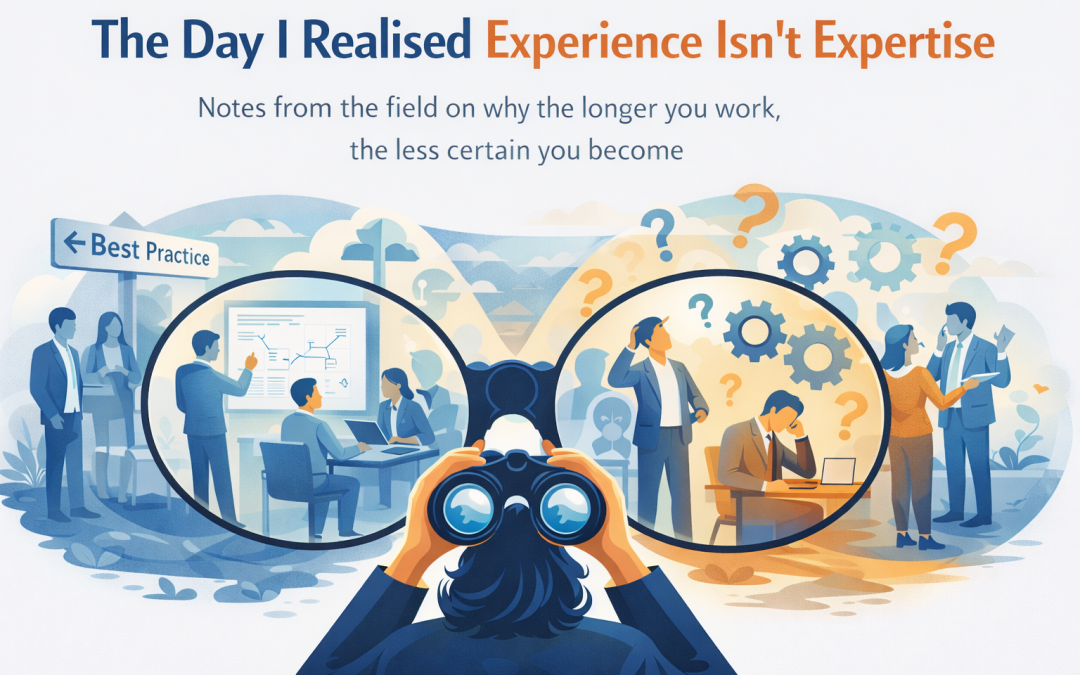
Notes from the field on why the longer you work, the less certain you become
A few years ago, I walked into a client meeting with the comfortable confidence that only experience can give you.
It wasn’t the loud, chest-out kind of confidence you have early in your career. It was quieter than that. Almost casual. The sort that whispers, You’ve seen this before. You know how this ends.
They were a growing services business. Revenue was healthy, but something wasn’t sitting right. Customer churn had started creeping up. The team looked perpetually stretched. Their CRM had been implemented with great enthusiasm and then quietly abandoned. The founders were in every decision, every escalation, every late-night email thread.
From the outside, it looked familiar. Comfortingly familiar.
I had worked with versions of this story many times before. In my head, I was already sketching the solution. Tighten onboarding. Clarify ownership. Redesign a few processes. Fix the CRM adoption. The usual suspects.
It felt almost efficient, like recognising the ending of a film halfway through.
And then, about twenty minutes into the conversation, I realised something slightly embarrassing.
I didn’t actually understand the problem at all. Not really because while the surface looked similar, the foundations were completely different.
The churn wasn’t onboarding-related. It had more to do with pricing psychology and mismatched expectations set during sales. The team’s overwhelm wasn’t a process issue so much as two unresolved interpersonal tensions that everyone was politely ignoring. And the CRM wasn’t failing because of poor training, they simply didn’t trust the data in it, so they avoided it altogether.
All the neat solutions I had mentally prepared would have missed the mark.
If I had rushed in with my “experience,” I would have confidently solved the wrong problem.
And there are few things more dangerous than confident incompetence dressed up as expertise.
I left that meeting with a strange mix of relief and humility. Relief that I had paused long enough to listen. Humility at how easily I could have been wrong.
That day quietly changed how I think about experience because I realised, experience isn’t the same thing as expertise.
Early in your career, you tend to believe that expertise means having answers.
You collect frameworks and models the way students collect notes. You learn the right language, the right diagrams, the right phrases. There’s a comfort in being able to respond quickly when someone asks a question. It feels reassuring, for them and for you.
Someone describes a problem and you say, “Ah yes, this is a classic case of X. Here’s what we’ll do.”
It sounds decisive, professional, efficient and for a while, that works.
Until you work with enough real businesses to realise that very little is ever “classic.”
Similar, yes. Identical, never.
The longer you stay in the field, the more you start noticing the small differences that change everything. Two companies might have the same org chart, the same tools, even the same revenue numbers, and yet one hums along while the other feels permanently exhausted. The surface similarities hide completely different human dynamics underneath.
Over time, the neat categories begin to blur and you find yourself using a phrase you once avoided because it sounded vague.
“It depends.”
It depends on the people. It depends on the history. It depends on what isn’t being said.
It depends on what the business quietly rewards.
“It depends” stops being a cop-out and starts becoming the most honest answer you have.
There’s a subtle pressure in consulting and leadership to sound certain. To be “the expert in the room.” To speak in conclusions rather than questions but if the last two decades have taught me anything, it’s that certainty is often theatre.
The people who sound the most confident are not always the ones who understand the situation best. Sometimes they’re simply the ones who stopped looking too soon.
The leaders I trust the most tend to have a different energy. They don’t rush. They don’t leap to diagnoses. They sit with the mess a little longer. They ask one more question than feels comfortable. They’re willing to say, “I’m not sure yet, let’s understand this properly.”
There’s something deeply reassuring about that kind of patience.
It doesn’t look impressive. It looks almost boring but it works, because real understanding takes time.
These days, when I start working with a new client, I notice how much slower I am than I used to be. Not slower in delivery, but slower in judgement.
I listen longer. I resist the urge to categorise too quickly. I pay attention to the throwaway comments, the hesitations, the jokes that aren’t really jokes. Often, the truth hides there rather than in the official slides.
Experience, I’ve learned, doesn’t give you answers. It rather gives you patterns and patterns are not prescriptions.
They’re clues. They help you recognise shapes, not solutions. They tell you where to look, not what you’ll find.
In that sense, experience is less like a manual and more like a map with a lot of “you are somewhere here” scribbled across it. Of course, very useful, but never exact.
There’s also a personal shift that happens.
When you’re younger, you want to prove you’re right. You want to demonstrate your value quickly. You want the room to feel your expertise.
Later, you realise the work isn’t about being right. It’s about being useful and being useful often means saying less, noticing more, and simplifying instead of complicating.
It means admitting that most problems aren’t technical puzzles waiting for a clever solution. They’re human systems that have drifted slightly out of alignment.
They don’t need brilliance and rather need clarity.
Sometimes they just need someone to slow down the room long enough for people to see what’s already obvious.
If anything, the longer I do this work, the more I feel like a student again.
Every new organisation teaches me something I didn’t know. Every time I think, I’ve seen this before, something small and unexpected proves me wrong and strangely, I’ve come to value that feeling.
The day I feel completely certain, the day I believe I truly have all the answers is probably the day I stop paying attention. In this line of work, paying attention is the whole job.
At Vani Malik Consulting, we don’t bring pre-packaged answers or generic “best practices.” What we bring is perspective, the kind that comes from years of watching what works, what quietly fails, and what sits somewhere in between.
Not expertise as certainty, but experience as curiosity because sometimes the most valuable thing you can offer a business isn’t a solution.
It’s the patience to say, “Let’s look at this properly.”

Hi, I’m Vani Malik, a business consultant now based in Colchester. For over 20 years, I’ve worked with global background screening and HR service companies, supporting clients across Europe, Asia, and North America.