
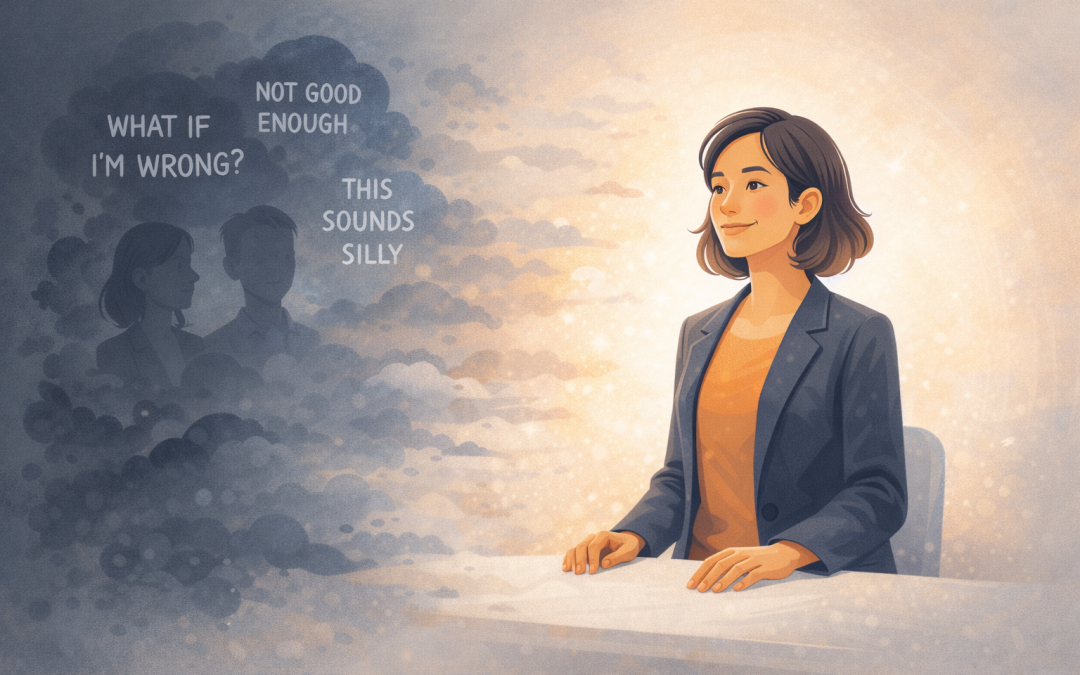
Why fear clouds our best thinking (and how to let it pass through)
This morning, I was telling my business partner what I wanted to write my next blog about.
“Fear,” I said. Not the dramatic, life-or-death kind. The quieter, everyday kind.
The kind that shows up five minutes before a presentation. Before an interview. Before sending that slightly bold email. Before saying what you actually think in a room full of senior people.
That kind of fear.
The very normal, very human, very inconvenient kind.
He listened. Nodded. And then, completely out of nowhere, started reciting something very seriously (mind you, he is a trained actor with degree in Drama):
“I must not fear. Fear is the mind-killer…”
For a second, I thought he had developed a new consulting framework overnight.
Turns out, he was quoting Dune by Frank Herbert – a book he loves and has been trying to get me to read for years.
And as theatrical as it sounded in morning over coffee…the lines stayed with me, because they weren’t philosophical. They were painfully practical.
Fear doesn’t make us incapable. It makes us noisy.
Here’s what I’ve noticed after years of meetings, boardrooms, transformations, interviews, negotiations, and the occasional “why did I agree to this?” moment.
When we’re calm, we’re sharp. When we’re curious, we’re creative. When we’re relaxed, we’re surprisingly articulate.
But introduce fear… and everything gets fuzzy like the boiling water.
Suddenly:
- we over-explain
- we under-speak
- we perform instead of think
- we say what sounds safe instead of what is true
Nothing about our capability changes.
Just our access to it. Fear is not the problem, the noise it creates is.
I’ve seen it everywhere
I’ve seen it in candidates who desperately need a job.
They’re brilliant on paper. Smart. Experienced. Capable, but the interview becomes a survival test.
“Don’t mess this up.” “Say the right thing.” “Don’t sound stupid.”
The pressure tightens their thinking.
Then I’ve seen the same people, months later, in casual conversations, relaxed, funny, insightful, full of clarity.
Same person. Different fear level. Different outcome.
I’ve seen founders do this too.
Holding back a bold idea because: “What if it sounds naïve?”
Or consultants softening their recommendations because: “What if this feels too radical?”
Or leaders staying quiet because: “What if I’m wrong?”
Everytime, the room loses something valuable, not because they didn’t know but because they were afraid to show what they knew.
The part of the quote that lingered
After my partner finished his dramatic morning recital, I looked up the full lines later and this part stuck:
“I will permit it to pass over me and through me, and when it has gone past… only I will remain.”
That’s exactly it. You don’t defeat fear. You don’t wrestle it. You don’t pretend it isn’t there. You just let it pass through.
Like a cloud and once it moves… clarity returns.
Not confidence. Not bravado. Just clarity.
Which, interestingly, is far more powerful.
The shift that changes everything
Over time, I’ve stopped treating high-stakes moments as “tests.”
I treat them as conversations.
Not: “This must work.” But: “Let’s see what happens.”
Not: “I can’t afford to fail.” But: “What can I learn here?”
It sounds small but it changes everything because when you stop protecting your image, you start accessing your thinking and your best ideas usually show up when you’re not trying to impress anyone.
Just trying to be honest.
Quiet courage beats loud confidence
I don’t think courage is loud and certainly it’s not chest-thumping or motivational speeches.
It’s much quieter.
It’s saying: “This is what I genuinely think.”
Even if your voice shakes a little.
It’s showing up as yourself instead of a polished version of yourself.
It’s allowing fear to walk through the room… without letting it sit at the table, because once it passes – Only you remain and honestly, that version of you is usually more than enough.
A gentle note from us at Vani Malik Consulting
Most business problems we see aren’t capability problems.
They’re clarity problems and clarity rarely comes from pushing harder.
It comes from slowing down enough to think without fear.
That’s where good decisions live. That’s where honest strategy lives and that’s usually where real progress begins.
“I must not fear.
Fear is the mind-killer.
Fear is the little-death that brings total obliteration.
I will face my fear.
I will permit it to pass over me and through me.
And when it has gone past, I will turn the inner eye to see its path.
Where the fear has gone there will be nothing.
Only I will remain.”
– Frank Herbert, Dune (1965)

Hi, I’m Vani Malik, a business consultant now based in Colchester. For over 20 years, I’ve worked with global background screening and HR service companies, supporting clients across Europe, Asia, and North America.