
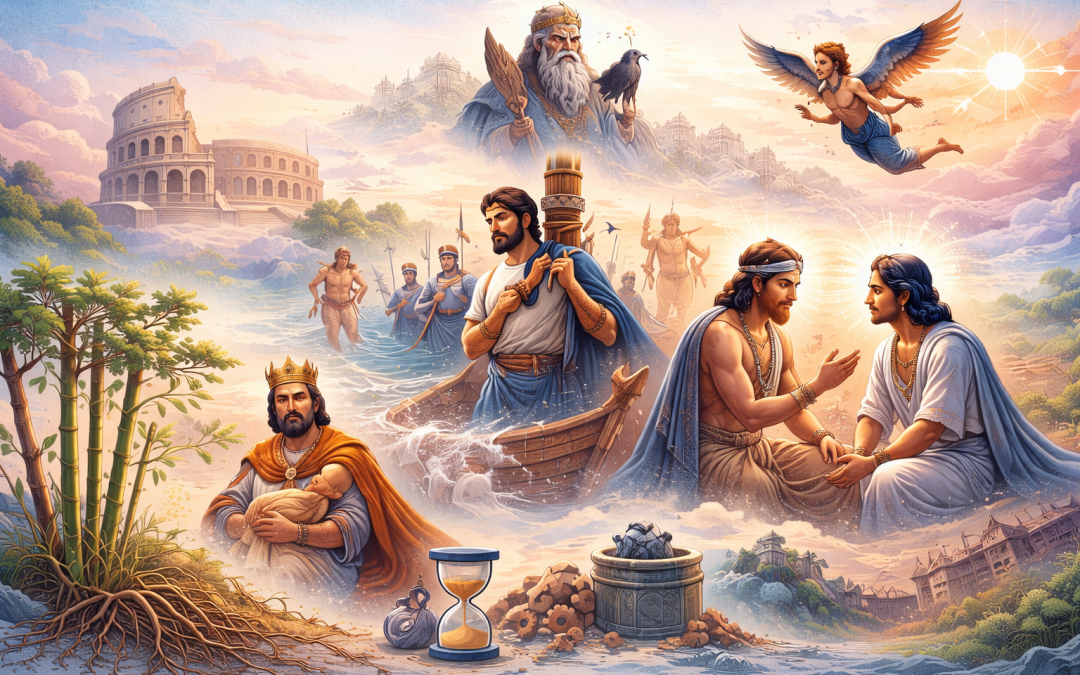
“Not everything that matters moves fast. Some things grow deep before they grow loud.”
Modern business worships speed.
Fast decisions. Fast growth. Fast scaling. Fast results.
We celebrate velocity as if it were wisdom. We reward decisiveness even when it’s detached from understanding. Somewhere along the way, we began to believe that moving quickly is the same as moving intelligently.
Ancient stories, from every corner of the world, quietly disagree.
What’s striking is not how different these traditions are, but how consistent their warnings have been for thousands of years.
The Illusion of Progress: When Faster Isn’t Forward
In today’s organisations, pausing is often mistaken for hesitation. Reflection is framed as indecision. Asking questions is confused with uncertainty.
Yet history repeatedly tells us: Progress without clarity is just movement.
Ancient Rome didn’t become powerful by expanding quickly. It expanded deliberately by building roads, governance, and systems before absorbing new territories.
Rome didn’t fall because it stopped growing. It fell when complexity outpaced coherence.
Modern businesses repeat this mistake daily: scaling teams, tools, and markets before stabilising culture, process, and purpose.
Greek Mythology: Odysseus and the Discipline of Anticipation
In Homer’s Odyssey, Odysseus survives not because he’s the strongest warrior, but because he understands his own limits.
When sailing past the Sirens, whose song lured sailors to destruction, Odysseus doesn’t trust willpower alone. He has himself tied to the mast and orders his crew not to untie him, no matter how much he begs.
This wasn’t fear. It was foresight.
In modern business, we often do the opposite. We trust future clarity instead of designing present safeguards.
Wisdom isn’t resisting temptation in the moment. It’s designing so temptation doesn’t win.
Eastern Philosophy: The Bamboo That Grows Before It Shows
A Chinese parable speaks of the bamboo tree that shows no visible growth for years while building a vast root system underground. When it finally grows, it does so rapidly – strong, flexible, resilient.
Many organisations want visible growth before invisible foundations.
They build websites before workflows. They hire before role clarity. They automate before understanding behaviour.
Strength without roots always snaps under pressure as what looks like slowness is often preparation.
Hindu Philosophy: Krishna and the Clarity Before Action
In the Bhagavad Gita, Arjuna stands paralysed on the battlefield. He is skilled, experienced, and respected and yet overwhelmed.
He doesn’t lack information. He lacks clarity.
Krishna doesn’t rush him or shame him. He reframes the problem entirely, shifting Arjuna’s focus from fear of outcome to dharma: right action aligned with purpose, not attachment.
“You have the right to action, not to the fruits of action.”
In modern leadership terms:
- Do the right work, not just visible work
- Build systems, not heroics
- Act with integrity, not urgency
Clarity precedes confidence.
Norse Mythology: Odin and the Cost of Wisdom
In Norse mythology, Odin sacrifices an eye at Mimir’s well to gain wisdom. The message is stark: clarity has a cost.
It requires giving something up be it ego, certainty, speed, or control.
Modern leaders often want insight without sacrifice. But every meaningful clarity demands trade-offs.
If clarity feels uncomfortable, it’s probably real.
Biblical Tradition: Solomon and Discernment Over Data
King Solomon is remembered not for conquest, but for discernment. In the story of two women claiming the same child, Solomon doesn’t rush to judgement. He creates space for truth to reveal itself.
He understood something we still struggle with: Data informs. Wisdom interprets.
Dashboards tell us what is happening and judgement tells us why.
Why Modern Organisations Struggle With Ancient Wisdom
The issue isn’t intelligence. It’s noise.
We are surrounded by tools, alerts, metrics, opinions, and urgency, with very little space to think.
Ancient leaders weren’t wiser because they knew more. They were wiser because they paid attention which is now one of the rarest leadership skills.
The Cost of Forgetting How to Pause
Across mythologies, impatience is punished.
Icarus flies too close to the sun. Pandora opens the box too soon.
These stories aren’t anti-ambition. They’re anti-recklessness.
In business, this shows up as:
- Scaling culture before it exists
- Automating chaos
- Delegating without clarity
- Chasing growth without stability
Then blaming people when systems fail them.
What Experienced Leaders Eventually Learn
After decades working across customer success, transformation, and complex organisations, one pattern stands out:
The leaders who endure aren’t the fastest. They’re the most deliberate.
They know when to slow down, not from doubt, but from awareness.
They understand that pauses prevent crises:
- Silence can be data
- Friction can be feedback
- Resistance can be insight
Why This Matters Now
Work is fragmented. Teams are distributed. Automation is accelerating. Attention is scarce.
In this environment, clarity becomes the real competitive advantage – neither louder leadership or more tools nor faster pivots.
But leaders who can think clearly amid complexity and design organisations that don’t rely on heroics to survive.
Final Thought
Across cultures, centuries, and civilisations, the message is strikingly consistent:
Clarity comes before action. Wisdom comes before speed.
Whether it’s Krishna guiding Arjuna, Odysseus binding himself to the mast, Odin paying the price for insight, or Solomon choosing discernment over haste, enduring leadership has always begun with clear seeing.
At Vani Malik Consulting, we help organisations slow down just enough to see clearly, so they can move forward with confidence, coherence, and intention.
Because the future doesn’t belong to the busiest leaders. It belongs to the clearest ones.

Hi, I’m Vani Malik, a business consultant now based in Colchester. For over 20 years, I’ve worked with global background screening and HR service companies, supporting clients across Europe, Asia, and North America.