
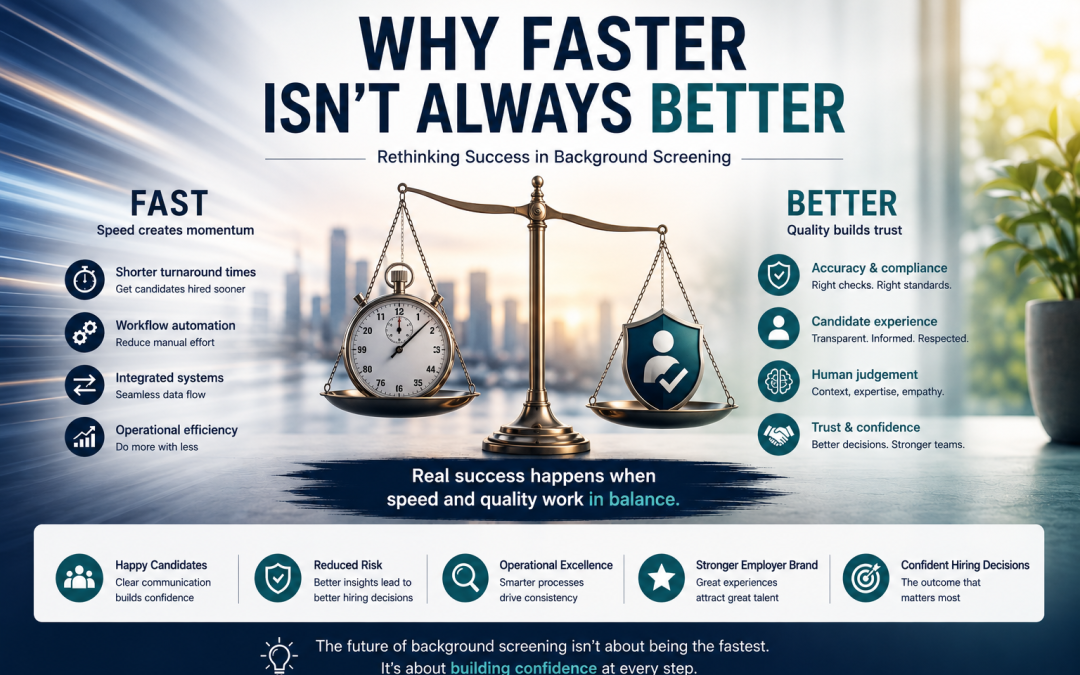
Discover why the future of background screening isn’t about turnaround times alone. Learn why trust, candidate experience and intelligent process design will define the next generation of screening.
For years, one metric has dominated conversations across the background screening industry – Turnaround time.
How quickly can a candidate be screened or how many checks can be completed in a day or perhaps how much faster is this process than last year?
These are important questions. In a competitive hiring market, reducing delays helps organisations secure talent, improves operational efficiency and shortens time-to-hire.
I believe the industry is approaching an important turning point as perhaps the next question shouldn’t be “How fast?” and rather it should be “How well?”
The Industry Has Become Faster
The progress over the last decade has been remarkable as automation now removes many repetitive administrative tasks and digital identity verification has reduced manual document handling. Integrated recruitment platforms have eliminated multiple hand-offs between systems and artificial intelligence is beginning to prioritise workloads, identify anomalies and support operational decision-making.
Collectively, these advances have transformed what organisations can reasonably expect from a screening programme.
There is no doubt that the industry deserves credit for embracing innovation however, innovation should never be confused with acceleration alone.
The real objective is not simply to complete checks faster and is rather to make better hiring decisions.
Efficiency Is Only One Dimension of Quality
Every operational leader understands the importance of efficiency – removing unnecessary manual effort creates capacity, reducing duplication lowers costs and standardising processes improves consistency.
These are all worthwhile outcomes, yet background screening is unlike many operational functions because every completed case represents an individual beginning a new chapter in their career.
Behind every dashboard is a person waiting for certainty, behind every delay is a hiring manager trying to build a team and behind every verification is an employer making a decision that affects their organisation, colleagues and customers.
That is why success cannot be measured by speed alone.
Better Processes Create Better Outcomes
The organisations leading the next phase of industry transformation are no longer asking how to automate everything.
Instead, they are asking where automation creates the greatest value as the routine, repeatable activities are increasingly being digitised.
Candidate communications are becoming more transparent and self-service capabilities continue to improve as well.
Artificial intelligence is helping teams focus attention where complexity genuinely exists.
Having said that, experienced professionals remain essential whenever judgement, context or regulatory interpretation are required.
This is not a competition between technology and people and is rather about designing processes where each contributes what it does best.
Candidate Experience Is Becoming a Competitive Advantage
One of the most significant shifts taking place across the industry is the growing recognition that candidate experience is no longer secondary.
Candidates increasingly expect the same simplicity from employment screening that they experience in digital banking, online retail and travel.
They want visibility, transparency and timely communication.
When these expectations are met, organisations strengthen employer brand long before the employee’s first day, however, when they are ignored, even a technically successful screening process can leave a negative impression.
Trust is built through experience, not just verification.
Lessons from Practice
One of the most rewarding initiatives I had the opportunity to contribute to was the development and management of WorkAttest at AuthBridge – an employment verification platform created to modernise one of the most time-consuming aspects of background screening.
The ambition was never simply to digitise an existing process as it was rather to rethink the experience for employers, candidates and verification teams alike by reducing unnecessary friction while improving transparency and efficiency.
Working on WorkAttest reinforced a lesson that continues to shape my thinking today that technology creates value when it simplifies complexity and a lasting impact when it improves trust though the two are not always the same.
That experience also highlighted something many organisations continue to discover today: successful transformation is rarely about replacing people. It is about enabling people to focus on higher-value decisions while technology manages the repetitive work that slows everyone down.
Looking Beyond Turnaround Times
As AI becomes more capable, the industry’s definition of success will inevitably evolve as the turnaround times will remain important, accuracy will remain essential and compliance will remain non-negotiable, however, organisations will increasingly differentiate themselves through qualities that are harder to measure – candidate confidence, operational transparency, responsible use of AI, thoughtful human judgement and the ability to combine efficiency with empathy.
These will become the characteristics that define industry leaders.
My Perspective
I don’t believe the future belongs exclusively to traditional screening providers or to digital-first disruptors.
The future belongs to organisations that successfully combine the strengths of both.
The operational discipline, regulatory knowledge and global expertise developed over decades remain incredibly valuable and equally valuable are the innovations being introduced around digital identity, automation, API connectivity and candidate-centric design.
So rather than replacing one another, these approaches are gradually converging and it is healthy for the industry because background screening has never really been about completing checks. It has always been about enabling confident hiring decisions.
Technology simply gives us new ways to achieve that objective, provided we never lose sight of the people those decisions ultimately affect.

Hi, I’m Vani Malik, a business consultant now based in Colchester. For over 20 years, I’ve worked with global background screening and HR service companies, supporting clients across Europe, Asia, and North America.