
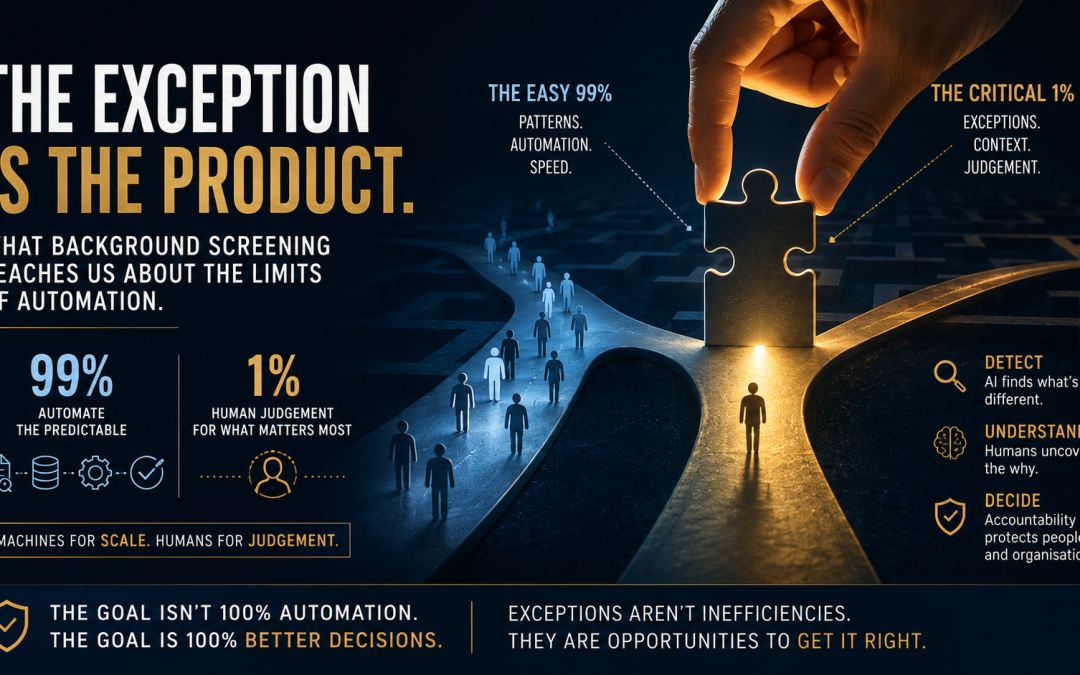
What background screening teaches us about the limits of automation
The real value of automation isn’t eliminating human judgement. It’s knowing where human judgement matters most.
Background screening has always contained a certain contradiction.
We want it to be fast, accurate, scalable with fewer manual interventions and increasingly, we want AI to help us achieve all four.
So naturally, the industry asks:
How much of background screening can we automate?
I think we should be asking a slightly different question.
What happens when the candidate doesn’t fit the workflow?
As that is where background screening becomes genuinely interesting and, increasingly, that may be where its real value lies.
The easy 99%
Imagine a screening workflow processing 100 candidates.
Ninety-nine are straightforward as the name matches, the date of birth matches, the university confirms the qualification, employment dates align. The source responds through the expected channel and the information is consistent so the workflow moves forward – No drama, no investigation and no reason for human intervention.
This is precisely where automation should excel.
It can collect information, trigger searches, reconcile data, communicate with candidates, update workflows and generate reports far faster and more consistently than humans can and that’s a good thing making a strong base for automation.
Then there is candidate number 100 – the university says the record cannot be found, the candidate’s name is slightly different from the certificate, the employer was acquired several years ago, the employment dates overlap as candidate worked for a subsidiary rather than the parent company. The institution has changed its name and the records sit in another jurisdiction. Suddenly, the workflow encounters something it wasn’t designed to understand and now we have a decision to make.
Is this an exception to be eliminated, or an exception to be understood?
A discrepancy isn’t necessarily a problem
This distinction matters enormously in background screening as a discrepancy simply tells us that two pieces of information don’t align.
It doesn’t tell us why – consider a name mismatch, yes, It could be a false identity or it could be marriage.
A transliteration difference, spelling variation, a middle name appearing in one record but not another, a perfectly legitimate change that happened years ago.
The data is telling us:
“These two things are different.”
It isn’t necessarily telling us:
“Something is wrong.”
That second conclusion requires context and context is where experienced screening professionals earn their value.
The same applies to employment
Imagine a candidate’s CV says:
January 2019 – December 2021
The former employer confirms:
March 2019 – February 2022
Is that a discrepancy – of course yes, but is it necessarily misrepresentation?
Not at all.
Perhaps the candidate’s notice period extended beyond the date they recorded pr perhaps they were on gardening leave or perhaps the employer’s HR records use a different definition of the employment start or end date or maybe there was a contractual arrangement that isn’t immediately obvious from the data.
The system has correctly identified an inconsistency.
But identifying an inconsistency and interpreting it are two very different tasks.
That distinction is going to become increasingly important as AI moves deeper into screening.
Automation is not the problem
Let me be clear that I am not arguing against automation as there is enormous value in removing repetitive, manual work from background screening.
Automation can:
- reduce turnaround times;
- improve consistency;
- reduce administrative errors;
- handle high-volume workflows;
- improve candidate communication;
- identify patterns;
- prioritise cases;
- create stronger audit trails;
- support quality assurance; and
- allow teams to focus on more complex cases.
The opportunity is enormous but there is a subtle trap.
We can become so focused on straight-through processing that we start treating human intervention as evidence that the process has failed.
I don’t think it is as sometimes human intervention is the point.
The exception is where expertise begins
This is perhaps the biggest mindset shift I would like to see in our industry.
We often talk about exceptions as though they are inefficiencies.
Something that needs to be resolved so the case can get back onto the automated path but what if we looked at them differently?
The 99% that follows a predictable path is where technology creates scale.
The 1% that doesn’t fit is where experience, judgement and investigation create value.
The exception isn’t necessarily the failure of automation as it may be the point at which expertise begins.
That is a very different way of thinking about automation.
And then came AI
AI makes this conversation even more interesting as AI can become exceptionally good at detecting patterns.
It can identify that:
“This record doesn’t look like the others.” or it can flag unusual dates, identify name variations, surface potential duplicate identities, prioritise cases and suggest possible explanations.
That is incredibly powerful but then comes the question:
What does the anomaly actually mean? – and this is where we need to be careful.
Detection is not interpretation
Suppose an AI system flags a candidate with an 87% confidence score.
Confidence in what?
That there is a mismatch?
That the mismatch is meaningful?
That fraud is likely?
That further investigation is warranted?
Those are completely different propositions.
The number may look reassuringly precise but precision isn’t the same as understanding.
This is where automation bias becomes a real concern.
A human reviewer may see an AI-generated conclusion and unconsciously give it more authority than they would give the underlying evidence itself.
The machine sounds confident so the human becomes less curious and that is precisely the opposite of what we need.
“Human in the loop” isn’t enough
We use the phrase human in the loop frequently.
But I’m not sure we always ask what it actually means.
Is the human:
- reviewing every significant exception?
- simply approving the machine’s recommendation?
- empowered to challenge the algorithm?
- accountable for the final decision?
- able to understand why the system reached its conclusion?
- trained to recognise when the model may be wrong?
There is a significant difference between human oversight and human accountability.
Putting a person at the end of an automated workflow doesn’t automatically make the process human-centred.
If that person is simply rubber-stamping what the system has already decided, we’ve not really preserved human judgement. We’ve rather automated the decision and retained a human signature and that’s not the same thing.
The stakes are different for the candidate
This matters because a background screening exception isn’t just a data problem.
For the screening company, it might appear as: Potential discrepancy requiring review.
For the employer: Potential risk requiring clarification.
For the candidate: “My job offer is now delayed.” Or worse – “I’ve been rejected.”
That changes the consequences of getting the 1% wrong.
A false positive isn’t simply an inefficient workflow as it can affect someone’s career.
A false negative can expose an organisation to significant risk.
So perhaps our definition of screening accuracy needs to mature.
Accuracy isn’t simply:
Did the system match the data?
It is also:
Did we reach a fair, proportionate and defensible conclusion from the data?
Global screening makes the 1% even bigger
Anyone who has worked across multiple countries will recognise another complication. There is no universal template for identity, education or employment as the names work differently, addresses work differently, date formats differ, educational systems differ, employment structures differ, government databases differ, verification practices differ, legal requirements differ and even the concept of an employer can vary.
An automated workflow designed around one market can therefore become surprisingly brittle when applied globally.
The more international the screening programme, the more important contextual intelligence becomes and this is one area where we should be cautious about asking AI to make the world appear simpler than it actually is.
The KPI problem
There is another conversation we don’t have often enough.
What are we actually rewarding our screening teams and technology platforms to achieve?
Suppose the primary KPIs are:
- faster turnaround;
- higher automation;
- fewer manual touches;
- lower cost per check;
- higher straight-through processing.
All sensible objectives but what happens when the right answer is:
“This case needs more investigation.”
That answer increases turnaround time as well as it increases manual effort.
It may reduce the automation percentage and on paper, the process looks less efficient but from a risk perspective, it might be exactly the right outcome.
This is where operational efficiency and decision quality can sometimes pull in different directions.
The fastest answer isn’t necessarily the best answer and a mature industry needs to know the difference.
So what should AI actually do?
Perhaps the question isn’t: “What should AI replace?”
Perhaps it is: “Where can AI make human judgement more valuable?”
Let AI handle the predictable and remove repetition. Let AI identify patterns humans might miss and algorithms prioritise cases. We can let technology create the scale.
Then give experienced professionals the time, information and authority to investigate the cases that genuinely require judgement.
That isn’t humans versus machines and is rather a division of labour.
Machines for scale. Humans for judgement.
Importantly: Humans should remain accountable for the decisions that carry human consequences.
The future isn’t 100% automation
I sometimes wonder whether we’re pursuing the wrong target. Why is 100% automation automatically considered the ultimate achievement, perhaps the goal should instead be: 100% appropriate automation.
Automate what is predictable and escalate what is ambiguous.
Explain what is uncertain, challenge what is consequential and preserve human judgement where context matters.
That may produce a slightly lower automation percentage but potentially a much higher quality of decision and isn’t that what the client is actually paying us for?
Not a beautifully automated workflow but rather a decision they can trust.
My Two Pence…
I’ve spent enough years in background screening to know that the cases you remember aren’t usually the straightforward ones.
They’re the ones where something didn’t quite make sense.
The university record looked wrong but wasn’t.
The employment dates appeared inconsistent but had a perfectly reasonable explanation.
The name didn’t match but the person did.
Those cases taught me something that I think becomes even more important as AI enters our industry.
An exception isn’t necessarily an error in the system. Sometimes, it’s an invitation to think.
We should absolutely automate the predictable and use AI to surface patterns, remove repetition and help us focus. However, we should and must be very careful about automating away the moments that require context, judgement and curiosity because in background screening, the value isn’t always in getting the easy 99% right.
Sometimes, the real value is knowing what to do with the difficult 1%.
That’s my two pence.
Questions I’d Love the Industry to Answer
- Where should AI draw the line between detecting a discrepancy and interpreting it?
- Are we measuring automation for its own sake, or measuring the quality of the decisions it enables?
- What does meaningful human oversight actually look like?
- How do we guard against automation bias when AI appears highly confident?
- Should an automated adverse finding ever stand without meaningful human review?
- Are our current SLAs and KPIs inadvertently rewarding speed over judgement?
- Can we design screening technology that knows when not to decide?
Perhaps the future of background screening isn’t about removing humans from the process and it’s rather about finally giving humans the time to do the work that only humans should be doing.

Hi, I’m Vani Malik, a business consultant now based in Colchester. For over 20 years, I’ve worked with global background screening and HR service companies, supporting clients across Europe, Asia, and North America.