
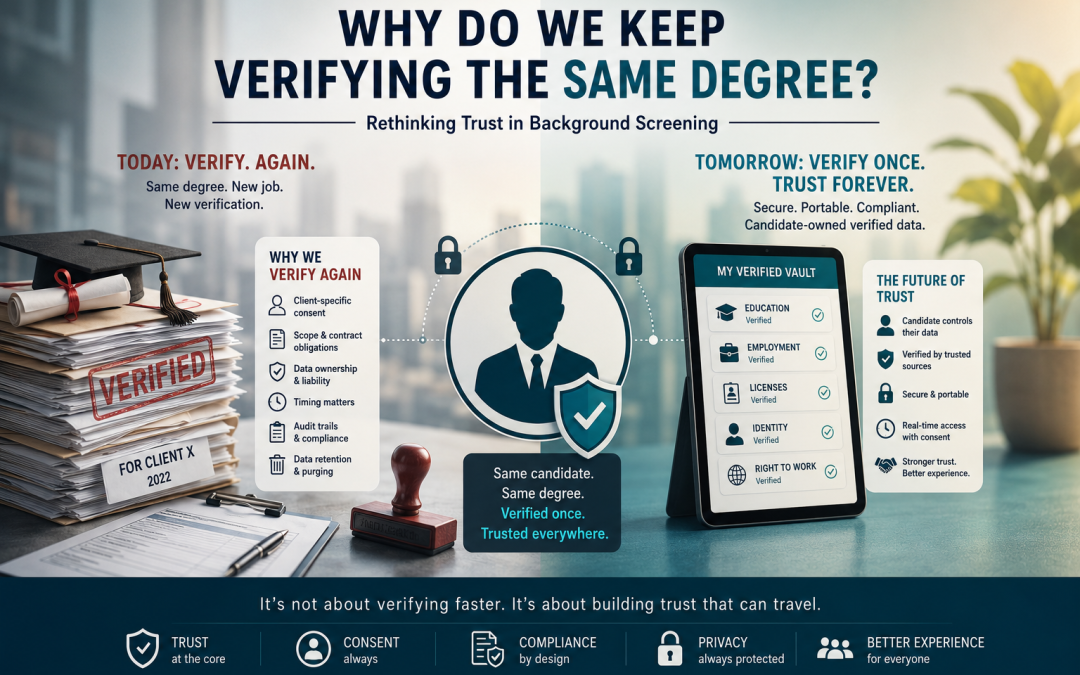
If a candidate’s degree has already been verified, why verify it again? Explore the legal, operational and technological realities behind reusable verification and portable trust.
Imagine this scenario – A candidate applies for a role as a mechanical engineer.
Their university degree is verified directly with the awarding institution by a background screening provider. The result is clear, accurate and delivered to the employer.
Two years later, the same individual applies for another engineering role.
Coincidentally, the new employer uses the very same background screening provider.
The qualification hasn’t changed neither has the university. The verification outcome hasn’t changed yet the entire process starts again.
The obvious question is: Why?
At first glance, it appears inefficient. If the qualification has already been verified, why repeat the exercise?
The answer reveals one of the most interesting and least discussed complexities within the background screening industry.
A Verification Is More Than a Verified Fact
Many people assume that a completed verification simply confirms whether a qualification is genuine. In reality, a background check is much more than that.
Every verification is carried out for a specific client, under specific contractual terms, with a clearly defined scope, based on the candidate’s consent at that point in time.
It represents a point-in-time opinion supported by evidence collected for a particular purpose.
The qualification itself may remain unchanged however, the legal, contractual and operational context surrounding that verification does not.
Why Can’t We Simply Reuse It?
Because background screening is built on much more than data.
Each completed verification sits within a framework that includes:
- Candidate consent
- Client-specific requirements
- Contractual obligations
- Regulatory compliance
- Audit trails
- Timing of the verification
- Data retention policies
- Secure data purging requirements
- Chain of custody for supporting evidence
- Liability and accountability
The report wasn’t created for the candidate or the industry.
It was created for one client, for one hiring decision, at one moment in time. That distinction changes everything.
The Hidden Challenge of Data Retention
One of the least visible challenges is data retention.
Privacy regulations around the world increasingly require organisations to retain personal information only for as long as there is a legitimate business purpose.
Once that purpose ends and agreed retention periods expire, records may need to be securely deleted.
That includes not only the final report but, in many cases, the supporting documents, communications, audit logs and evidence that underpinned the verification.
Even if the qualification itself never changes, the evidence used to verify it may no longer exist.
This is one reason why reusing previous verifications is far more complex than it first appears.
Verification vs Evidence
This distinction is becoming increasingly important.
A university degree is a fact and the verification is evidence supporting that fact.
Facts can remain true indefinitely however, evidence is governed by consent, retention policies, legal obligations and operational controls.
Understanding the difference is essential as the industry explores new digital models.
Lessons from Practice
During my time at AuthBridge, I had the opportunity to co-create and manage WorkAttest, a digital employment verification platform designed to modernise one of the industry’s most manual processes.
One question consistently surfaced during its development:
Why are organisations repeatedly verifying information that has already been verified?
What became clear was that the challenge was never simply one of technology.
It was about – governance, trust, ownership, consent, interoperability.
Creating a digital platform was only one part of the equation. The harder challenge was designing a model where verified information could be shared responsibly without compromising privacy, compliance or accountability.
Those questions remain just as relevant today.
Are We Asking the Wrong Question?
Perhaps the industry has been asking:
“Why can’t we reuse verifications?”
Maybe the more valuable question is:
“How could we create a trusted ecosystem where verified information becomes portable while maintaining candidate control, organisational confidence and regulatory compliance?”
That shifts the conversation completely.
Instead of repeating work, we begin exploring how trust itself might become reusable.
My Two Pence
I don’t believe the future of background screening lies in simply verifying information more quickly.
I believe it lies in redesigning how trust is created, maintained and shared.
Financial services have embraced secure data sharing, healthcare is steadily moving towards portable health records and digital identity is becoming increasingly accepted across many sectors.
Employment verification may follow a similar journey but only if the industry can solve the challenges of governance, consent, liability and interoperability.
The technology already exists but the bigger question is whether we can build the frameworks that allow trust to move as confidently as data.
That, in my view, is one of the most exciting conversations our industry should be having.

Hi, I’m Vani Malik, a business consultant now based in Colchester. For over 20 years, I’ve worked with global background screening and HR service companies, supporting clients across Europe, Asia, and North America.