
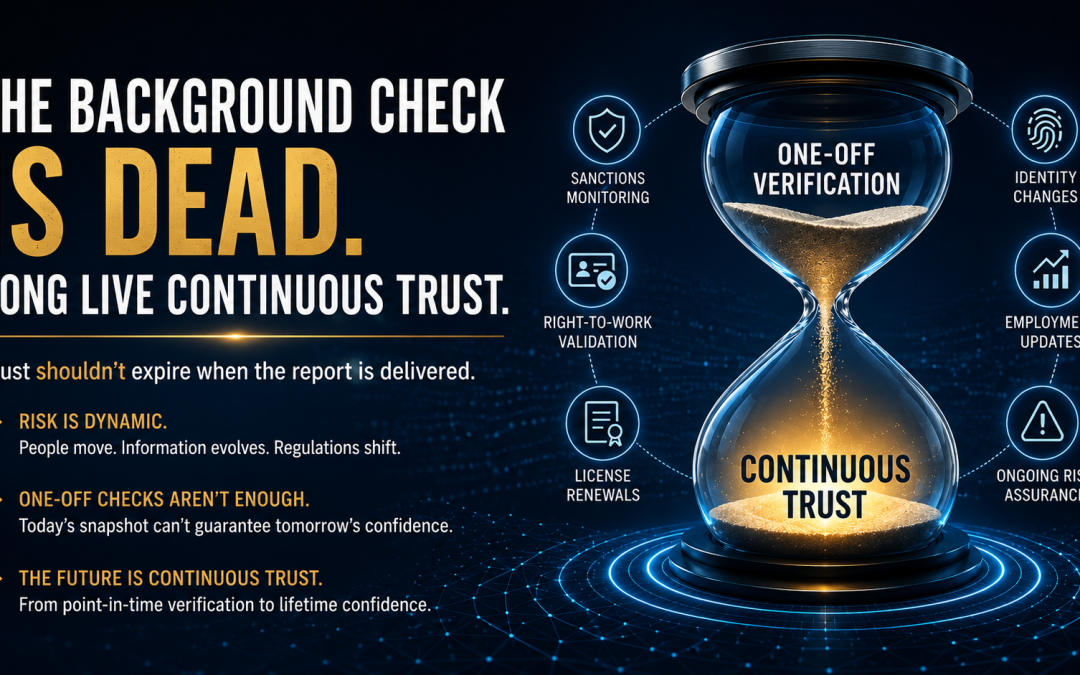
“The greatest assumption our industry continues to make is that trust can be established at a single point in time.”
For decades, the background screening industry has been built around a remarkably simple idea.
A candidate applies for a job, an employer commissions a background check, information is verified, a report is produced, a hiring decision is made and the file is closed. Job done.
It is a model that has served organisations well for many years. It is also a model that is becoming increasingly difficult to defend, not because background screening has stopped working. It is rather that the world in which it operates has fundamentally changed.
The question that has been occupying my mind recently isn’t whether background screening is still relevant, it unquestionably is. The question is far more uncomfortable.
Are we still solving today’s problems with yesterday’s operating model?
Background Screening Was Designed for a Different World
To understand where we might be going, it’s worth reminding ourselves where the industry came from. Background screening evolved around recruitment as it was designed to answer a straightforward question:
“Can I trust this person enough to hire them today?”
Everything about the operating model reflects that objective – how checks are commissioned, evidence is collected, information is verified, a report is issued and the engagement ends.
That approach made perfect sense when employment was relatively stable, hiring cycles were slower and access to data was largely manual.
Trust was treated as a milestone, something that could be established, documented and filed away.
But today’s workforce looks very different as people move jobs more frequently and at times, even work across multiple countries.
Professional licences evolve, right-to-work status changes, sanctions lists are updated daily, digital identities continue to develop throughout an individual’s career and risk has become dynamic.
Yet our industry still largely delivers trust as though it were static.
We Don’t Verify People. We Verify Moments in Time
This, in my view, is one of the biggest misconceptions in our industry. We often describe background checks as though we are verifying people but we are not.
We are verifying information that exists at a specific point in time –
A degree may never change, a passport eventually expires, a professional licence requires renewal, a sanctions database changes tomorrow, an employment record grows with every new role and even identity itself can evolve through marriage, citizenship or legal name changes.
Every background check is therefore a snapshot, accurate when completed, perhaps potentially incomplete tomorrow.
That doesn’t reduce its value but it should influence how we think about it.
Perhaps a background check isn’t the destination and it’s simply the starting point of trust.
The Industry Has Quietly Started Moving
Interestingly, many parts of the industry have already recognised this shift and make continuous sanctions monitoring, adapt ongoing media monitoring, do periodic right-to-work validation, monitor licences and even monitors driver status.
These services exist because organisations understand that certain risks cannot be managed through a one-off assessment.
Instead of asking, “Was this true when we hired them?” they increasingly ask, “Is this still true today?” That subtle change represents something much bigger than an additional service offering.
It signals a change in philosophy as the industry is slowly moving from verification to assurance, from static reports to dynamic confidence.
Continuous Trust Is More Than Continuous Screening
This is where I believe the conversation becomes more interesting.
Continuous trust is not simply about checking people more often, It is rather about rethinking the entire lifecycle of verified information – Who maintains it? Who updates it? Who decides when it has expired? What should trigger a fresh verification? Who owns the audit trail? How should consent evolve? When should supporting evidence be securely purged? What happens when different jurisdictions have different retention requirements?
Technology can automate reminders, artificial intelligence can identify anomalies, digital identity platforms can improve portability but none of these answers the fundamental question.
Who is responsible for maintaining trust over time?
That is not a software problem, It is a governance challenge.
Why This Matters More Than AI
Artificial intelligence currently dominates conversations across almost every conference, webinar and industry publication and rightly so as AI will undoubtedly reshape how information is gathered, analysed and presented.
However, I sometimes wonder whether we are asking AI to solve the wrong problem.
Making a one-off verification faster is valuable, making trust sustainable is transformational.
The future of our industry won’t be determined by which organisation builds the most sophisticated AI. It will rather be determined by those that build the most trusted governance models around AI.
Trust has never been created by algorithms alone. It has always depended upon transparency, accountability, evidence and human judgement.
AI changes how we work whereas governance determines whether people continue to trust the outcome.
A Lesson the Industry Has Learned More Than Once
The idea of creating reusable, candidate-controlled or portable credentials is far from new.
Across different countries, private organisations, industry collaborations and government-backed initiatives have all explored ways of allowing individuals to carry verified employment, education or skills information throughout their careers.
Some initiatives demonstrated genuine innovation and some solved very real operational problems, yet relatively few became part of everyday hiring.
It has not been like that because the technology wasn’t capable but because technology was never the hardest part.
Success depended on something much more difficult – shared trust:
Would employers rely on credentials they hadn’t commissioned? Would regulators accept them? Would educational institutions participate consistently? Who would fund the ecosystem? How would liability be shared? How would consent be refreshed?
How would organisations reconcile different retention obligations, particularly once supporting evidence reached the end of its lawful retention period and needed to be securely purged?
These questions reveal something important.
The future of background screening is unlikely to be determined by a single platform or a single provider. It will be determined by whether an entire ecosystem can agree on common principles for creating, maintaining and sharing trust.
Perhaps We Need a New Mental Model
Maybe we’ve been thinking about background screening in the wrong way. Instead of viewing it as a report…
Perhaps we should think of it as a living trust framework – One that evolves throughout an individual’s career, one where verified information remains connected to its provenance, one where consent is transparent, where audit trails are preserved, where privacy is respected, where evidence is retained only for as long as it should be and securely removed when it should not, where technology reduces friction and governance preserves confidence.
That is a very different vision from simply completing checks more quickly.
My Two Pence…
Every industry eventually reaches a point where its operating model is challenged by the world around it – banking experienced it, healthcare is still navigating it and identity management is evolving through it.
I believe background screening is approaching that same crossroads.
For decades we’ve become exceptionally good at answering one question:
“Can I trust this candidate today?”
The question I think we should now be asking is different – “How do we preserve trust tomorrow?”, because trust doesn’t end when a report is delivered.
It evolves, it matures, sometimes it strengthens and sometimes it needs to be questioned again.
If the next decade belongs to organisations that understand that distinction, then perhaps the future of our industry won’t be defined by faster background checks.
It will be defined by something far more valuable.
The ability to build confidence that endures beyond the hiring decision.
That’s my two pence.
Questions I’d Love the Industry to Answer
- Are background checks still being designed around recruitment rather than long-term workforce risk?
- Should confidence become a lifecycle rather than a deliverable?
- What should trigger a new verification and who should decide?
- Can continuous trust exist without continuous surveillance?
- What governance frameworks will be needed before AI can truly transform background screening?
- If we were designing our industry from scratch today, would we still define success by a report delivered at a single point in time?

Hi, I’m Vani Malik, a business consultant now based in Colchester. For over 20 years, I’ve worked with global background screening and HR service companies, supporting clients across Europe, Asia, and North America.