
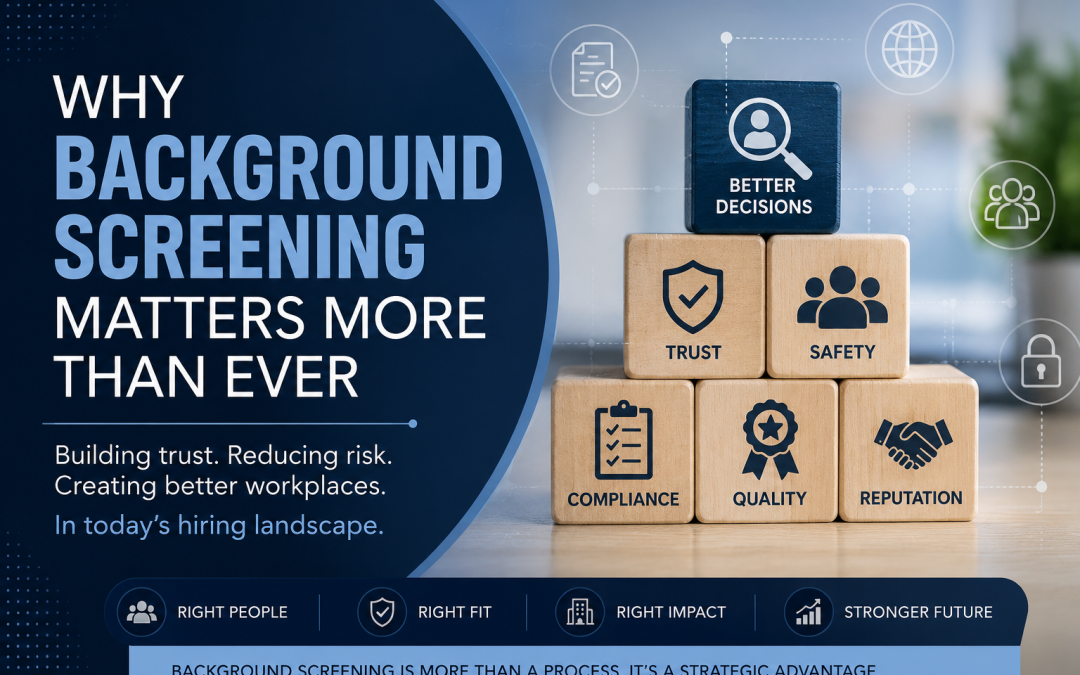
Discover why background screening has become a strategic business function, helping organisations build trust, improve hiring decisions and prepare for an AI-driven future.
For many organisations, background screening has traditionally been viewed as a final administrative step before a new employee starts. A necessary compliance exercise, completed quietly in the background and often unnoticed when everything goes according to plan.
However, today’s hiring landscape tells a very different story.
The way organisations recruit, onboard and manage talent has changed dramatically over the last few years. Hybrid working, global recruitment, remote onboarding, increasing regulatory expectations and rapid advances in technology have transformed background screening from a back-office function into a strategic business capability.
Having worked within the background screening industry for many years, I’ve seen first-hand how organisations often underestimate the value that an effective screening programme can deliver. While reducing hiring risk remains essential, the true value lies in building trust, protecting reputation and creating a positive experience for both employers and candidates.
Background Screening Is About Trust
Every recruitment decision is ultimately built on trust:
Employers trust that candidates have represented themselves accurately.
Candidates trust that organisations will treat their information responsibly and fairly.
Customers trust businesses to employ people who meet the standards expected of them.
Background screening provides the evidence that strengthens that trust. When designed well, it helps organisations make informed decisions while giving candidates confidence that the recruitment process is transparent, consistent and professional.
The Hiring Landscape Has Changed
Organisations are no longer recruiting only within their local markets. Talent is increasingly global, remote and mobile.
At the same time, hiring managers are under pressure to recruit faster than ever before while maintaining high standards of compliance and candidate experience.
This creates a difficult balance – move too slowly and organisations risk losing talented candidates to competitors and move too quickly without appropriate verification then organisations expose themselves to unnecessary operational, legal and reputational risks.
Finding the right balance is becoming one of the defining challenges for modern recruitment teams.
Technology Is Transforming the Industry
Artificial intelligence, automation and digital identity verification are changing how background screening is delivered.
Routine administrative tasks that once required significant manual effort can now be completed much faster, allowing screening providers to improve efficiency and reduce turnaround times.
This is undoubtedly a positive development. However, technology should be viewed as an enabler rather than a replacement for professional judgement.
Not every discrepancy is straightforward. Not every document tells the full story. Complex cases often require context, experience and thoughtful decision-making, qualities that technology alone cannot provide.
The future of background screening will belong to organisations that successfully combine intelligent automation with experienced human oversight.
Candidate Experience Matters More Than Ever
One of the biggest changes I’ve observed is the growing importance of candidate experience.
Background screening is often one of the first meaningful interactions a new employee has with an organisation after accepting an offer.
Long delays, unclear communication or unnecessary requests can leave candidates feeling frustrated before they have even joined.
Conversely, a well-managed screening process builds confidence and demonstrates professionalism from day one.
Candidate experience should not be considered separately from operational efficiency as the two go hand in hand.
Looking Beyond Compliance
Too often, organisations measure the success of background screening purely by turnaround times or completion rates, while these metrics are important, they tell only part of the story.
Successful screening programmes also improve communication between HR, hiring managers and screening providers, reduce operational friction, support better decision-making and strengthen organisational trust.
These outcomes are harder to measure, but they often create the greatest long-term value.
Looking Ahead
Background screening is entering a period of significant transformation.
Artificial intelligence will continue to reshape processes. Digital identity solutions will become more sophisticated. Regulatory requirements will evolve, and candidate expectations will continue to rise.
The organisations that succeed will be those that embrace innovation without losing sight of the human element. Each has a critical part to play as a part of well-integrated team – Technology can make background screening faster and People ensure it remains fair, thoughtful and trusted.
In my view, that balance will define the future of our industry.
This blog marks the beginning of a series exploring the future of background screening, operational excellence, customer success and the role of AI in creating more effective, human-centred screening programmes. I look forward to sharing insights, practical experiences and ideas that can help organisations navigate the opportunities and challenges ahead.

Hi, I’m Vani Malik, a business consultant now based in Colchester. For over 20 years, I’ve worked with global background screening and HR service companies, supporting clients across Europe, Asia, and North America.